Friday, August 30, 2013

Hey, I curated a show called, Lady Painters, through Pop-Up Art Loop.

23 E. Madison St.
Current Exhibit: Lady Painters
Gallery Hours: Wednesday - Friday, noon - 6 pm; Saturdays, noon - 4 pm
Opening Reception: Thursday, September 12th 5-9pm
Gallery Address: Frogman Gallery, 23 E. Madison St.

Lady Painters is a three-person exhibition featuring painting and installation by artists Karen Azarnia,  Angela Bryant, and Melody Saraniti.  

About the artists:

KAREN AZARNIA
Karen Azarnia received her MFA in Painting and Drawing from the School of the Art Institute of Chicago in 2008, and her BFA from Rhode Island School of Design. She has exhibited widely, including solo exhibitions at the Union League Club of Chicago, IL; the Riverside Arts Center, IL; as well as recent group shows with the South Logan Arts Coalition, Chicago, IL; and Julius Caesar, Chicago, IL. She has been awarded multiple CAAP grants, Individual Artist grants from the Illinois Arts Council, and currently
serves as Director of the Riverside Arts Center Freeark Gallery. This fall she will attend a residency at Oxbow in Saugatuck, MI.


ANGELA BRYANT
Independent Curator, Gallery Director of Design Cloud, Owner/Director of Abryant Gallery and Consultation, Director of Exhibitions for O’Connor Art Gallery. As a curator, Angela Bryant has coordinated multiple exhibitions and shown over 100 artists. In addition to being the Gallery Director of Design Cloud, she is also the Director of Exhibitions for O’Connor Art Gallery at Dominican University where her programming highlights the work of both emerging and established artists in two‐person and group exhibitions.
In 2009, Angela founded Abryant Gallery, an art consultation service and rotating contemporary art gallery that focuses on young/new and emerging artists. In addition to being a curator, she is also an artist and the recipient of several awards and honors including the Presidential Scholarship Award, the Archibald Motley Award for Ragdale Artist Colony, and the Non‐Representational Award for the 36th Annual Beverly Art Center Competition. Her professional practice includes teaching as an adjunct professor, as well as experience as a jury member, a panelist, and a guest lecturer at multiple institutions. Angela holds an MFA in painting and drawing from The School of the Art Institute of Chicago and has exhibited work in multiple locations including The Merchandise Mart and The Korean Cultural Center.


MELODY SARANITI
Melody Saraniti received her BFA from Kent State University and her MFA from The School of the Art Institute of Chicago in 2009. She has exhibited in several venues including the Noyes Cultural Center in Evanston, IL and the Hyde Park Arts Center. She has been awarded four CAPP Grants, and was a resident of Oxbow and The Vermont Studio Center. Saraniti has shown regularly with Thomas Masters Gallery and was recently the Artist in Residence for the South Logan Arts Coalition.

Exhibition Curated by Gwendolyn Zabicki: Director, Frogman Gallery

Frogman Gallery is committed to showing the work of emerging and mid-career artists in Chicago. The name Frogman comes from the group of top secret WWII divers trained in underwater combat. Like a scrappy Italian commando, Frogman Gallery appeared from nowhere and may disappear at anytime.

Space Provided By:
Marc Realty

http://www.popupartloop.com/active.php?id=108

PUAL Sponsors
PRESENTING SPONSOR
Columbia
ART MATERIALS SPONSOR
Blick
APPAREL SPONSOR
Carhartt
PHOTOGRAPHY SPONSOR
Smilebooth

Saturday, August 24, 2013

Mural Painting in Rogers Park


My pal Kent and I are painting a mural in Rogers Park. Here is how we did it. First, you should clean the walls with muriatic acid. Then, we primed the walls with two coats of masonry primer/sealant.


We had the mural printed out in black and white in actual size on cheap paper. We traced the back of this paper with compressed charcoal.


Then we traced the front of the mural with thick graphite pencils and it left a charcoal ghost behind.


The bottom half of the transfer process. Measure carefully. Use a level and painters tape.


We went over the charcoal ghost with sharpie markers. The sharpie bleeds through paint, so the lines show if you go over them.


Painting (back to front).


Almost done. We will touch up the bottom later and add a black trim around the entire mural when the other sections are finished.


Blocking in another section. This is a drawing of the old Granada Theater in Rogers Park.


A beach scene.


We will paint this in tomorrow because it was raining today. Paint misbehaves in the rainy weather.


Back the next day to paint.
A view of from the train of the old Granada Theater (torn down in the 70's or 80's, I think). We have a little more work to do on the outlines.


This is where we were on the end of day 3 of painting.


This was the end of day 5 of painting. We put a black trim around the mural. 


When we finished painting, about 8 days of work, we coated the entire mural in a polyurethane based sealant. It goes on milky and dries clear.  

We returned the next week, to coat the mural in an anti-graffiti coating.


We special ordered this sacrificial anti-graffiti coating from the Home Depot. If someone tags the mural, we can remove the tag (along with this coating) with pressure and hot water. Then a new sacrificial coat must be applied. 


My favorite part of the mural might be the electrical conduit that we had to paint over in the top right corner of this picture. I love little things like that. 

Friday, August 23, 2013

Vanitas Skull

Just finished this vanitas painting for an Anti-Defamation League fundraiser. Not my usual subject matter, but it was a fun painting challenge. 


vanitas skull
oil on panel
15in x 15in x 3in
2013

Thursday, August 22, 2013

The Act of Killing


Just saw The Act of Killing. It might be the most important film ever made. The filmmaker uses a technique borrowed from Hamlet to trick a war criminal into feeling guilt. This Slate article explains it well: 

http://www.slate.com/articles/arts/history/2013/07/the_act_of_killing_essay_how_indonesia_s_mass_killings_could_have_slowed.single.html

http://theactofkilling.com/


Friday, August 16, 2013

Required viewing. James Burke: Connections, Episode 1


These are the kinds of thoughts that keep you up at night. An excellent program and worth adding to your queue. 

Wednesday, August 14, 2013

The Ghosts of Place-- Dylan Trigg


From The White Review: http://www.thewhitereview.org/features/the-ghosts-of-place/

THE GHOSTS OF PLACE

 ’So I turned around for an instant to look at what my field of vision onto the sea had not offered up: the heavy grey mass where traces of planks lined up along the inclined ramp like a tiny staircase. I got up and decided to have a look around this fortification as if I had seen it for the first time, with its embrasure flush with the sand, behind the protective screen, looking out onto the Breton port, aiming today at inoffensive bathers, its rear defence with a staggered entrance and its dark interior in the blinding light of the gun’s opening toward the sea.’ – Paul Virilio, Bunker Archaeology

IT IS OCTOBER 2010 AND I AM IN THE KITCHEN OF AN OLD HOUSE IN SUSSEX. FROM THE KITCHEN, A DOOR LEADS TO THE HALLWAY. SUDDENLY THE DOOR BEGINS TO SWAY FROM SIDE TO SIDE. AT FIRST, I THINK NOTHING OF IT AND PUT IT DOWN TO A BREEZE FROM ANOTHER ROOM. BUT THEN THE SWAYING BECAME MORE DELIBERATE, AS IF A PRESENCE WERE TRYING TO COMMUNICATE FROM AFAR. THE DOOR MOVES TO ONE END, PAUSES FOR A SECOND, AND THEN PROCEEDS TO RETURN TO THE OTHER SIDE. TO AND FRO IT MOVES, UNTIL SUDDENLY, AND WITHOUT WARNING, IT STOPS. AS I STAND TO INVESTIGATE, AN IRIDESCENT LIGHT FILLS THE HALLWAY, AND A TALL SILHOUETTE CLAD IN BLACK SLOWLY CROSSES THE LANDING BEFORE DISAPPEARING INTO THE BRICK WALL. IN RESPONSE, THE SKIN ON MY BODY BECOMES CLAMMY WITH ANXIETY, WHILE THE HAIRS BEGINNING AT THE BASE OF MY HEAD AND EXTENDING TO THE LOWER REACH OF MY NECK RECOIL, AS IF THEY HAD GRASPED SOME KIND OF HORROR THAT I WAS STILL IN THE PROCESS OF EXPERIENCING. ONE MINUTE LATER, I AM ON THE STREET.

Disturbed by the vision, I look at the house from the vantage point of the outside. If the figure has come to me in a moment of private intimacy, then I am sure it would not follow me down the stairs and onto the other side of the street, and thereby expose itself to the public gaze. On the contrary, I am fairly convinced it is still inside, likely oscillating between the landing on the hallway and the kitchen, where – so I assume – it may have once encountered some kind of trauma that led it to being affixed to this place in time.
How many other people had seen the figure since the conception of the house in the fifteenth century? Numerous people no doubt through the centuries, each of whom will have had their own story to tell. In addition, all of these people will have had their own interpretation of the figure, from the seventeenth century interpretation of spectres as restorers of social injustices of the living to the nineteenth century interpretation of the such sights as a figure of death that refuses to die, thus offering hope that in an increasingly secularised age, life after death remains possible.

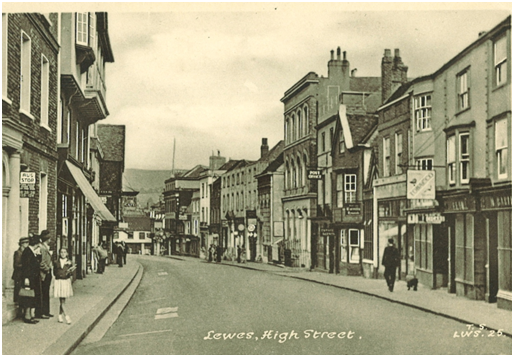
70 High Street is at the right of this photo, just next to the man walking the dog 

In all this, I may well form part of a historical community that will have encountered this vision in this particular place, 70 High Street, Lewes, Sussex. What did the figure want from us all: to testify to its mournful existence, to become its voice, or simply in the act of affecting another person, to remind itself that it still holds the power to form an alliance with the living? And why did it choose us? Are we in some sense more receptive to the troubled dreams of those who refuse to die than other people? Did the figure sense an anxiety within each of us that renders our senses more attuned to ambiguous forms of life?


***


What is a ghost? The question has gained a particular value in the last decade or so owing to the influence of Derrida’s concept of hauntology, a pun on ontology referring to the spectre of Marxism. As it is understood in a post-Derridean context, the concept refers to a broad range of cultural phenomenon characterised, above all, by a certain collapse in the spatio-temporal order, signalling the radical collision of old and new. It is a Ballardian vision of time, in which the end has already occurred and we are now – perhaps unknowingly – living in its shadow.

The term figures in a variety of mediums, from the archival restoration of ‘abandonware’ and ‘dead tech’, to the music of both Caretaker and the retro pastiche of Belbury Poly together with the associated Ghost Box Music label. In films, the theme is evident in works such as Peter Weir’s Picnic at Hanging Rock (1975) and Nic Roeg’s Don’t Look Now (1973). Alongside these mediums, the image of the urban ruin being reclaimed by wild mangroves, the drained swimming pool of an abandoned hotel, and the decommissioned remains of war bunkers would all be central motifs for the hauntologist. In each of these forms, the hauntological aesthetic plays out in terms of an appeal to the uncanny: that is, to the re-emergence of what was originally repressed, but only now—through an accidental rupture in the present – comes to light. Such an aesthetic has its roots in Freud, and can then be mapped out in the work of surrealists and their usage of anachronism, before then resurfacing in Walter Benjamin’s philosophy of history, which will later re-appear once more in the works of W. G. Sebald, and in a contemporary guise, in artists such as Cyprien Gaillard and Gregory Chatonsky.

Today, there is a danger that the theoretical treatment of hauntology has become academically and culturally canonised, and therefore rendered sterile. Indeed, increasingly the term is marked less by a critical interrogation of the past and more with an uncritical if not sentimental affirmation of a certain type of obsolete culture and sensibility that has its roots in 1970s British and to a lesser extent North American media. Into this framework, the category of the ghost has assumed a significant role. But only now, the presence of the ghost plays a metaphorical role, not as an actual spectre of the undead, but as a device that enables the voice of the overlooked past to finally be heard. It is an aesthetic of liberation, therefore, aligned with an admirable political orientation, but which is less at the service of the ghost itself and more the voice the ghost speaks through.


***


Were we to employ hauntology as means of understanding what a ghost is, then we would fall short of achieving our goal. If the theoretical model provides ghost hunters with the means of accessing the underside of a politically structured society, then it leaves us little insight into the nature of the ghost itself. Against hauntology, let us turn in the diametrically opposite direction: cognitive neuroscience.

For a neuroscientist such as Peter Brugger, the ghost has its place, not in the ruined castles of a childhood memory, nor even in the dank alleyways hidden within cities at night, but in the brain itself. What is a ghost? For Brugger, it is reducible to a tendency in visual perception to identify order within an arbitrary configuration.[1] Brugger turns to the example of August Strindberg’s visions, as they figure in his From an Occult Diary. Brugger presents us with an overview of Strindberg’s ‘apophenic reactions’ to random patterns. Of configurations in clouds, Strindberg ‘sees the form of a hind in the clouds and believes the nodding of her head is a special sign’. Likewise, when confronted with sticks in a box, Strindberg reports the following: ‘I opened an enormous chest, empty except for five sticks, painted black. What they were intended for I did not know, but they were arranged on the bottom of the chest to form a pentagram. Who has played this trick on me and what does it mean?’ 

Brugger’s response to these sightings is to align them with a schizophrenic propensity to overproduce meaning in things, an act that is as much dependent on apophenia as it is an urge to create. This ‘borderland of creativity’ can be explained in terms of what Brugger terms a ‘disinhibition of associative processes’. By this, Brugger refers to the tendency characterising schizophrenic patients to link words with incongruent associations. In the manner of Andre Breton’s psychic automatism, the schizophrenic or Strindbergian perspective is purportedly no stranger than an exaggerated version of aligning red with danger or similarly associating green with the motion of speeding up. In turn, this model can also explain paranormal phenomena such as ghosts, especially, so Brugger writes, ‘if the target words are exposed to the subject’s left visual field’.

What is important for Brugger about the phenomena of hauntings is not the content of the hauntings themselves, but what these experiences can reveal about the cognitive structure of the brain. If the hauntological treatment of the ghost treats the phenomena in no more than figurative terms, then in Brugger’s diametrically opposed framework, the ghost becomes a sort of error in perception that ultimately science, in its research on electrophysiology and electroencephalography, will one day be able to explain fully. And yet far from leading us closer to the ghost, this scientific reduction instead abstracts the ghost from its place of haunting and deprives it of all but a strictly cognitive meaning.

To return to Strindberg. Tellingly, one of his apophenic reactions is to a crumpled pillow. There, Strindberg reports the following interpretation: ‘…I once found my pillow, which I had crumpled when taking my midday rest, so moulded that it looked like a marble head in the style of Michelangelo… These occurrences could not be regarded as accidental, for on some days the pillow presented the appearance of horrible monsters, of gothic gargoyles, of dragons, and one night… I was greeted by the Evil One himself.’

As lovers of ghost tales know too well, the image of crumpled linen is one that haunts the imagination of ghost writers. Most obviously, it plays an especially important role in the venerated story by historian and academic, M. R. James, ‘Oh, Whistle, and I’ll Come To You My Lad’. In the story, a Cambridge don, Professor Parkins, is on holiday in a seaside resort on the Suffolk coastline. On a walk along a cliff edge, he encounters a discarded whistle engraved with the words,Quis est iste qui venit (‘Who is this who is coming?’). In response to the question, the Professor blows the whistle. That night, he is kept awake by the noise of wind accompanied by a vision. On the beach, the Professor sees a distant object:

Rapidly growing larger, it, too, declared itself as a figure in pale, fluttering draperies, ill-defined. There was something about its motion which made Parkins very unwilling to see it at close quarters. It would stop, raise arms, bow itself toward the sand, then run stooping across the beach to the water-edge and back again; and then, rising upright, once more continue its course forward at a speed that was startling and terrifying.[2]

Yet again, the following night, the figure on the beach comes closer, this time into the Professor’s room itself. It begins with a rustling noise, and then a ‘figure suddenly [sat] up in what he had known was an empty bed’. Leaping from his bed, the apparition advances toward him with arms outstretched, ‘Now it began to move, in a stooping posture, and all at once the spectator realised, with some horror and some relief, that it must be blind, for it seemed to feel about it with its muffled arms in a groping and random fashion.’ As the spectre moves into the light of a full moon, it reveals itself for what it is: ‘an intensely horrible, face of crumpled linen’. The story ends with Professor Parkins, hitherto a man of logic and rigour, in a state of nervous collapse, with his rational views ‘on certain points…less clear cut than they used to be’.

James’s story signals the collapse of reason and imagination, and thus plays to both the cultural (hauntological) and scientific (reductive) account of ghosts. In the case of the former theory, the past refuses to remain buried but instead finds its expression in the chance encounter of an old whistle on the edge of a cliff. This collision of fate and chance serves to inadvertently summon a past that was there all along, only dormant.

Exemplary of the logic of hauntology, M. R. James draws together a constellation of different eras in the same figure; namely, the figure of the spectre emerging from the sand on the Suffolk coastline, a coastline that – significantly – was the haunting ground of another ghost collector: W. G. Sebald. The gesture of imbuing an otherwise placid landscape with the phantoms of antiquity is central to hauntology. Only in the case of hauntology, the past is not a remote one but instead a time that has been compressed, dating back a mere no more than thirty or forty years – that is, largely to the childhood of those who assign their own past as the site of a haunting.

The conclusion of James’s story points to the insufficiency of a reductive account of ghosts. The image of the Professor in a state of collapse, his rational foundations broken by the rupture of an anachronic timescale, in which the existence of a ghost materialising from crumpled linen becomes a tenable reality, is enough to undermine the scientific account of the ghost as simply being an epistemic error in perception. Something more than cognitive processes must be accounted for if we are to address the role both science and culture can play in shaping the ghost.


***


Once more, I am standing outside of 70 High Street, Lewes. The figure in black who crossed the landing before disappearing into the brickwork is nowhere to be seen, save that of a memory that from time to time I might again experience in my body. In the moonlight, the house reveals itself in a partial glimpse. The place has a life of its own, quite apart from the manner in which it is experienced by me. And yet, without the living, there are no ghosts. If the ghost of a place resists the category of cultural symbol and is equally ill-at-ease in being a fault or excess in perception, then this does not mean it inhabits the mind alone, therefore denying its reality in the external world. Rather, something takes place between the viewer and the spectre that renders the dialogue between the living and the semi-living possible. This ambiguity is inherent in our relationship with places, be it in the ruins of an abandoned fort or in the harshly lit tunnels of a subway station at night. In each case, the genius loci reveals itself as precisely that which resists our understanding and instead constitutes a place as both the site of a haunting but also the haunt to which we return time and again.


Tuesday, July 30, 2013

A five minute video explanation of Neorealism

From Earnie Park in Sight & Sound magazine // May 2013
“The only great problem of cinema seems to be more and more, with each film, when and why to start a shot and when and why to end it.” – Jean-Luc Godard
Worth watching: http://vimeo.com/68514760

What is neorealism? from kogonada on Vimeo.


Saturday, July 27, 2013

July 2013 SLAC article on Chicago Artists Resource


South Logan Arts Coalition: Artists Helping Artists, Helping Neighbors


SLAC Puts Artists in Vacant Storefronts, Recharges a Neighborhood


South Logan Arts Coalition
Any artist working in Chicago knows all too well the challenges of finding studio space that is both affordable and accessible. We’ve all spent hours searching for work space with cheap heat and good ventilation, in a decent neighborhood, close to public transit and maybe even modifiable. But how many emerging artists can afford to pay for what is essentially the price of a second apartment, plus utilities? Even sharing can be risky; if a partner suddenly leaves, you could get stuck with the bill. Most of us don't take the risk, working out of a spare bedroom or sharing a damp garage with two or three other creative hopefuls.
Despite the overwhelming need for artist studios in Chicago, not many Chicago property owners care to address it. It is rare to find owners of buildings that are willing to work with the zoning and insurance issues that come with renting creative workspaces. Luckily, there are artists and arts advocates in the Chicago community that took notice of this need and took action.
Gwendolyn Zabicki, co-founder of the nonprofit South Logan Arts Coalition, not only found a unique way to support her creative peers and beautify her neighborhood, but she got what she wanted more or less for free. She and SLAC partners Jason Walker and Joe Tighe, the three of whom make up the SLAC board of directors—encourage Logan property owners to donate temporarily their unused storefronts and facilities to artists to use as pop-up studio spaces.
"I think it’s extremely important to attract and retain creative people."
To participate in SLAC’s program, non-matriculating, Logan Square-based visual artists are invited to submit proposals to be considered for a temporary storefront studio space. Accepted artists are provided a storefront studio for a period ranging from 30-90 days. They are also eligible for studio visits with established artists and curators. Because the artists are often working in storefronts, they have built-in opportunities to exhibit their work in the windows, and to host open studio events that are advertised by SLAC at no cost to the artist. SLACtakes no commission on works sold through the spaces
To say Gwendolyn and her team were able to run SLAC for “no cost” is not to say that they didn’t have a long list of obstacles that would prove both challenging and time-consuming. SLAC spent months working with Chicago aldermen, contacting neighborhood associations, communicating with volunteer arts attorneys and introducing themselves to dozens of property owners in Logan Square.
The SLAC board of directors, artists themselves, sets an example for the kind of relationships that artists can and should have with their communities and creative peers. Architect and Logan Square property owner JulesLapkus recognizes this. He has already benefited from SLAC’s efforts and creative energy.
“I took over this space four or five months ago. I had just put a sign up for rent and I wasn’t getting any calls. [Gwendolyn Zabicki] just came by and knocked on my door,” says Lapkus, describing the process of installing working neighborhood artists into his space.  “When we pulled up the Venetian blinds with the art, people started contacting me. I got five calls the first week because people can actually look in, and it’s not so foreboding.”
Lapkus’s collaboration with SLAC has inspired the construction of a new studio space on Diversey Avenue behind the Hairpin Lofts. As an architect, he is interested in working with Logan Square artists to give them the facilities they need to have affordable and functional workspaces in their own neighborhood.
“[The new space comprises] three storefronts and what I want to do is get that property occupied,” saysLapkus. “The [artists] can work in the three storefronts, split it up any way [they] want. I’ll provide the heating and the air conditioning, ventilation and new plumbing … clean up facilities, the bathrooms, wash-bins, whatever they need … I’ve got multiple buildings that fit into this scenario that are empty right now.”
Lapkus adds there is a yard behind the three Diversey storefronts that link up to Milwaukee Avenue. He hopes to install a privacy fence there to allow the artist-residents the option to invite the public inside for exhibitions and open studio events.
“I think it’s extremely important to attract and retain creative people ... I don’t want this area to turn to Manhattanization, [where a neighborhood] gets richer and richer and richer, and it becomes hollowed out,”
South Logan Arts Coalition has been instrumental in recharging parts of Logan Square and its storefronts. What used to be stretches of empty, boarded-up windows have been revitalized as tenanted, active studios boasting their own works-in-progress in the windows.
One of the most valuable aspects of being an artist is the ability to problem solve creatively—to approach obstacles with a unique perspective. South Logan Arts Coalition confronted the serious lack of affordable work space in Logan Square, and found a win-win-win solution that is good for the artists, the property owners and the neighborhood. SLAC’s program has had direct results—an inspired property owner determined to bring more a permanent studio solution to Diversey Avenue. Now: who’s going to step up and support the artists in your neighborhood?
The South Logan Arts Coalition is a nonprofit organization made up of Logan Square residents who support and value the arts. We serve as a facilitator between the owners of empty storefronts and artists from the Logan Square area. Our goals are to award local artists free, temporary work studios; improve the appearance of the southwest commercial corridor in Logan Square, with a focus on Armitage Avenue west of Western Avenue; and give artists increased visibility through promoted open studio events and studio visits from curators and established artists.

Read the article here: http://www.chicagoartistsresource.org/articles/south-logan-arts-coalition-artists-helping-artists-helping-neighbors

Sunday, July 07, 2013

Never A Lovely So Real

I have a new pop-up gallery downtown, which I've named Frogman. This space is mine to curate for the next six months to a year! My second show, Never A Lovely So Real, is opening this Thursday, July 11th (6 to 9pm). You can see install photos here: http://www.flickr.com/photos/nvaughn/sets/72157634575182342/

And a visit from photographer and writer Paul Germanos here: http://www.flickr.com/photos/73059802@N00/9268574985/

Clarissa Bonet, 2013

“Never a lovely so real” is a phrase from Nelson Algren’s Chicago: City On The Make. In the novel, Algren tells the story of Chicago’s history though its hustlers, hop-heads, and old cokey-joes “on the prowl for one last wandering square.” Ultimately, Algren declares his love for the city: "Once you've become a part of this particular patch, you'll never love another. Like loving a woman with a broken nose, you may well find lovelier lovelies, but never a lovely so real." 

About the Artists:
Clarissa Bonet (b. 1986 Tampa Florida) Lives and works in Chicago. She received her M.F.A. in photography from Columbia College Chicago in 2012 and her B.S. in Photography from the University of Central Florida. Her work has been exhibited in Chicago, California, New York, among other places as well as internationally in Paris and at the Pingyao International Photo Festival in China. She was the recipient of the Albert P. Weisman grant for two consecutive years. Her work is in the collection of the South East Museum of Photography and Calumet Photographic. In 2012 she was in the top 50 of Critical Mass, won PDN’s the Curator; search for undiscovered fine art photography. Most recently she has been chosen as a winner in Magenta Foundation’s 2013 Emerging Photographer exchange.http://clarissabonet.com/

Dmitry Samarov was born in the USSR in 1970; emigrated with his family to the US in 1978; graduated from SAIC with a BFA in Painting & Printmaking in 1993; published Hack: Stories from a Chicago Cab in 2011; lives and works in Chicago, IL. He no longer drives a cab.
http://www.dmitrysamarov.com/

Noah Vaughn is a Chicago-based artist whose work primarily deals with depicting overlooked and vernacular aspects of the built environment. He received a BFA in Painting and Drawing from the School of the Art Institute of Chicago in 1993, and has been working with photography since 2007.http://noahvaughn.com/

Frogman Gallery is committed to showing the work of emerging and mid-career artists in Chicago. The name Frogman comes from the group of top secret WWII divers trained in underwater combat. Like a scrappy Italian commando, Frogman Gallery appeared from nowhere and may disappear at anytime.

This exhibit was made possible by the generous help and support of the Chicago Loop Alliance. For more information, please visit:

http://www.chicagoloopalliance.com/
http://www.popupartloop.com/
http://www.facebook.com/ChicagoLoopAlliance

Gallery hours:
Wednesday- Friday noon to 5:30pm


Frogman Gallery is located inside the Block 37 building, 108 N. State St, ground floor, Chicago, IL 60602

Wednesday, July 03, 2013

Milwaukee Avenue Arts Festival-- mention in Bad At Sports


The scene on Milwaukee Avenue this weekend.

Milwaukee Avenue Arts Festival Roundup

As if Logan Square wasn’t already the best neighborhood in Chicago (sorry haterz), this weekend’s Milwaukee Avenue Arts Festival was the perfect combination of art, craft and deliciousness. The festival had everything: boneless rib sandwiches, hot dogs, cheese burgers, italian sausages, cheese fries, funnel cakes, Wisconsin cheddar curds, corn dogs, chicken strips, cheese sticks, cheese curds, nachos and potato skins. Here are a few of the highlights:
All of the things!
Lisa Lindvay somehow managed to make Doritos gorgeous at one of the SLAC storefront exhibitions
We loved Natalie Krick’s clever use of the dressing rooms in the abandoned clothing store where one of the SLAC exhibitions took place.
WTT? is a longtime GDBD fan, so we were of course delighted to see member Jamie Steele’s work, Lady(2013) at MAAF.
The extremely lovely and extraordinarily talented Nadine Nakanishi at her booth for Sonnenzimmer.
Aron Gent’s cardboard palace for Document &Threewall‘s joint booth at the Milwaukee Avenue Arts Festival.
Orange: No further proof needed than the ongoing and extreme popularity of the negroni slushies from Parson’s Chicken & Fish.
Mobile negroni slushie’s at MAAF this weekend. Photo via Parson’s Facebook.

LS Alderman, Rey Colón, checking out a photo by Garrett Baumer at one of the SLAC’s pop-up art exhibitions on Milkwaukee.