Tuesday, October 30, 2012

What A Long Night It Has Been


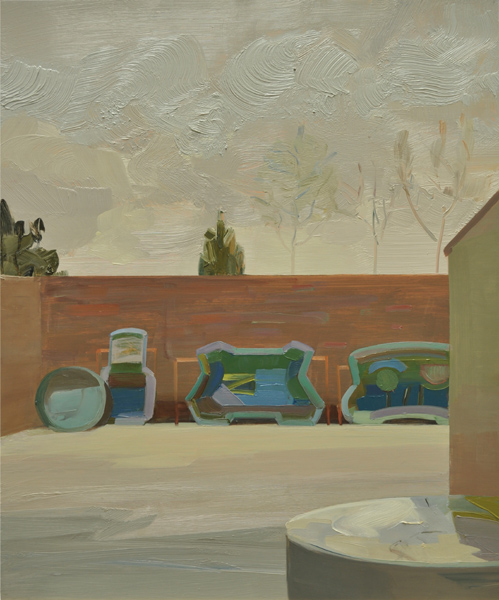
I had some paintings in a group show at Northern Illinois University in DeKalb, IL. Wish I could have made it down there. 


What A Long Night It Has Been- Gallery 214, Visual Arts Building at Northern Illinois University in DeKalb, IL.


Sunday, October 14, 2012

Washington D.C.


I recently went to D.C. to see the George Bellows exhibit at the National Gallery. It was excellent of course, but there is just so much to see in D.C. The Smithsonian alone has 19 separate museums. My favorite surprise piece was The Laundresses (1899) by Theophile Alexandre Steinlen. This work was totally new to me and hidden away in the basement of The National Gallery. The composition is very odd-- the faces of the laundresses are hidden by, well, laundry. But the low-light and slice-of-life feeling of this painting make it very compelling.

Tuesday, September 25, 2012

Expo Chicago


Did anybody see the Koen Van Den Broek paintings at Expo Chicago? They were my favorite.
I was very happy to see work by all my old favorites:

Steven Coyle
Wayne Thiebaud
Will Cotton
Ed Burtynsky
Nico Munuera
Richard Hull
Paul Winstanley
Alice Neel

Wednesday, August 15, 2012

Cleveland Trip


I recently flew to Cleveland and got to see some great American paintings at the Cleveland Museum of Art. 

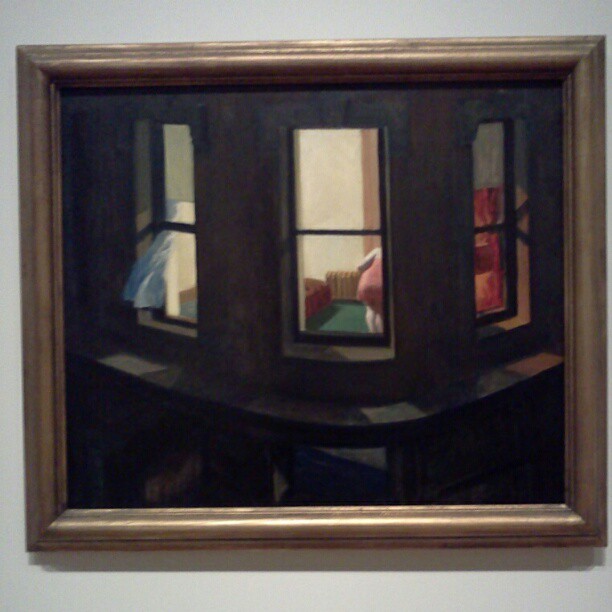
I wrote about Edward Hopper's Night Windows (1928) in my grad school thesis paper. As I looked at it, I remembered that my thesis advisor told me she learned to paint by looking. And it's really true. If you spend enough time with a painting you really can suss out how it was put together, using which colors and in what order. 


I also saw this great still life, Spring Interior (1927) by Charles Scheeler. I always see the same few Sheeler paintings in books and at the Art Institute of Chicago. I was never crazy about his work, but when I saw this painting, it felt totally fresh and different to me. Each branch is just exactly where it needs to be. It is the kind of painting that I would point to as an example of how sometimes composition can feel like perfection. I can't say why, but when it's good you just know it. I get so excited when an artist I thought I knew (and didn't really care about) does something that surprises me and I love it and then it all makes sense. 


Tuesday, August 14, 2012

How the Art World's Lingo of Exclusivity Took Root, Branched Out, And Then Rotted From Within


A great article about art speak from artinfo: 


The hypnotizing argot of the art world is familiar to anyone who has ever tried to decipher a gallery press release or encountered a nebulous artist statement. It’s a vocabulary of modified adjectives and abstract nouns, of concepts that get deconstructed and ideas that get interrogated, distributed practices and embraced ambiguity. In a recent article for the innovative web publication Triple Canopy, Alix Rule and David Levine coin the term “International Art English” (shorthanded “IAE,” roughly equivalent to the popular nickname “artspeak”) to describe this language, tracing its history and divining its murky rules. IAE “always recommends using more rather than fewer words,” the authors write; it “sounds like inexpertly translated French;” is marked by an “uncanny stillness;” and has a heavy “dependence on lists” (guilty as charged).
Rule and Levine have arrived at their findings by sorting through the past 13 years of press releases from e-flux, an online art project and distribution platform founded by artists Anton Vidokle, Julieta Aranda, Adriana Arenas, Josh Welber, and Terence Gower in 1999 that sends out paid-for announcements to its 90,000-plus-member email list. Rule and Levine loaded the collected press releases into Sketch Engine, a piece of software that analyzes linguistic behavior and trends from bodies of text. The tendencies that they discovered are obvious in retrospect — an overreliance on adverbs, repetition of adjectives, and a preponderance of subordinate clauses — but more striking is their outlining of the past and possible future of IAE....
Within the art world, International Art English is everywhere at once; it’s the air we breathe, a medium for communication rather than the content of communication. What was once elite is devalued, a process that has coincided with the growth and gradual mainstreaming of contemporary art that continues in the 21st century. Similarly, but in a broader sense, the action of curating is now devalued to the point of meaninglessness, where to curate simply means to exist, or to select, as any competitive animal has always done, one thing above another, slightly worse thing. The curator is dead, victim to omnipresence. Long live the curator.
Read the rest here:


http://www.artinfo.com/news/story/817400/how-the-art-worlds-lingo-of-exclusivity-took-root-branched-out-and-then-rotted-from-within


Thursday, July 12, 2012

A great article on the state of painting


From: http://henrimag.com/blog1/?p=5936


Our age is retrospective. It builds the sepulchres of the fathers. It writes biographies, histories, and criticism. The foregoing generations beheld God and nature face to face; we, through their eyes. Why should not we also enjoy an original relation to the universe? Why should not we have a poetry and philosophy of insight and not of tradition, and a religion by revelation to us, and not the history of theirs? Embosomed for a season in nature, whose floods of life stream around and through us, and invite us by the powers they supply, to action proportioned to nature, why should we grope among the dry bones of the past, or put the living generation into masquerade out of its faded wardrobe? The sun shines to-day also. There is more wool and flax in the fields. There are new lands, new men, new thoughts. Let us demand our own works and laws and worship. Ralph Waldo Emerson Nature
Back to the Future
Emerson wrote this lament about America and Americans in the 1830s, and it seems, even at that early date in our history we had become nostalgic for an imagined arcadia. We Americans enjoy, engage and covet the blissful comforts of nostalgic revery – from the orderly certitude of manicured lawns and white picket fences all the way to the ironic discomforts of Andy Warhol’s two-toned wig. We are in love with our own mythologies, crave the retelling and representations of our origins. And in our Postmodern Age that kind of nostalgia runs rampant in our culture. We have come to accept and expect it’s presence in nearly everything we engage with, especially in painting. And the current end of gallery season summer extravaganzas offer hardly any surprises in this regard.
Right now you can walk into any number of studios of abstract painters in New York City and see contemporary “advanced painting” that looks and acts very much like this 1927 Painting by Miro:


Thursday, June 07, 2012

Mairead O'hEocha

Garden, Duncormick, Co.Wexford
Oil on board
49 x 63 cm
2011


Thursday, May 10, 2012

Greta Waller


Greta Waller
My Rejection Letter, 2008
oil/linen
18 x 24 inches

This is just great. Why didn't I think of painting this?

Tuesday, March 27, 2012

Violet Baxter

Signs, 2008, Oil on Panel, 12 x 12 in.


Nightlights I, Oil on Panel, 14 x 11 in.


Watertower Still Life, 2009, Oil on Panel, 16 x 20 in.


Monday, March 26, 2012

Byron Thomas


Pine Trees, 1946, oil on canvas, 40" x 28" in.

Paintings I would like to see in person:


"Tear Gas and Water Hoses," Edward Biberman,1945.


"Movies-Canton Island,"
Paul Sample, 1943.


"Night Hauling," Andrew Wyeth, 1944.

Friday, March 23, 2012

Harry Leith-Ross


Gloucester Wharf, 1935


Flag Station, 1945


Saturday, March 03, 2012

Wish I had seen this show: George Ault


To Make a World: George Ault and 1940s America, was at the Smithsonian American Art Museum from March 11 – September 5, 2011.

To Make a World captures a 1940s America that was rendered fragile by the Great Depression and made anxious by a global conflict. Although much has been written about the glorious triumph of the Second World War, what has dimmed over time are memories of the anxious tenor of life on the home front, when the country was far distant from the battlefields and yet profoundly at risk. The exhibition brings viewers back into the world of the 1940s, drawing them in through the least likely of places and spaces: not grand actions, not cataclysmic events, not epoch-making personalities, posters, and headlines, but silent regions where some mystery seems always on the verge of being disclosed.


Friday, March 02, 2012

Fabulous quote from Peter Schjeldahl


In this week's New Yorker, Peter Schjeldahl reviews a Cindy Sherman retrospective at the Museum of Modern Art. He also puts into words something that I have been struggling with for years-- the ability of art language and art writing to suck the life out of art. He starts off by quoting the wall text:

"Masquerading as a myriad of characters, Cindy Sherman invents personas and tableaus that examine the construction of identity, the nature of representation, and the artifice of photography." The images do no such thing, of course. They hang on the walls. The pathetic fallacy of attributing conscious actions to art works is a standard dodge, which strategically de-peoples the pursuit of meaning. Such boilerplate language has trailed Sherman since her emergence, more than thirty years ago, in the "Pictures Generation" of media-savvy artists who tweaked conventions of high art and popular culture, sometimes in tandem with theory-bent, iconoclastic academics and critics. The association made for a rich episode in the history of ideas, and a spell of heady distraction in that of art. The intellectual vogue is long over, though the pedantry lingers, presuming that the mysteries of Sherman's art-- photographs that are like one frame movies, which she directs and acts in-- demand special explanation. (She is remarkably tolerant of interviewers who keep asking her what she means, as if, like any true artist, she hadn't already answered in the only way possible for her: in the work.)

The rest of the article is pretty great too.

Favorite art words used this week in spring midterms:

Parallax
Syntax
Relational Aesthetics
Agency
Dichotomy
Ethnographic
Effulgent
Indexical
Synthesis


Favorite art words used last semester:
Emphatic
Solipsistic
Axiom
Hegemony
Shibboleth
Reification
Pedagogy
Reflexive
Praxis
Materiality
Social Practice
Inchoate
Morass


Thursday, March 01, 2012

Kurt Solmssen


There is a great interview with painter Kurt Solmssen on the painting perceptions blog:


He paints outside, from life. His paintings have wonderful, dark shadows and a mix of crisp and loose lines.


Tuesday, February 28, 2012

New Paintings- midterms


This is what I showed at midterms:

Gerhard Nordstrom


Admiring the beautiful paintings of Gerhard Nordstrom today. He's 87 years old and known for his anti-war paintings of the 70's. He is perhaps Sweden's most famous painter. His usually pleasant nature paintings often have dead bodies hidden in them.

Monday, February 20, 2012

Studio and Garden: At the Met: John F. Kensett, Minimalist


Studio and Garden: At the Met: John F. Kensett, Minimalist: Sometimes we are reawakened to an artist's work by seeing it in a new context, which scrubs our eyes clean and opens a space in our mind. This happened to me during my recent visit to the Metropolitan Museum of Art's new American Wing. In a gallery devoted to 19th century landscape painters, one stood out for me in a startling way: John Frederick Kensett. It's as though I saw a completely new painter, one who looked at the world with a sense of its essential nature, and who left the extraneous behind. A painting: sea and sky, the light of sunset gently touching the waves, the only diagonals barely traced in the upper sky. A painting full of light, but not drama; an everyday glory.


Eaton's Neck, Long Island, 1872; oil on canvas, 18 x 36 in.


A curve of beach and hillock sweep into the space of sky and sea, each element in perfect balance.


Eaton's Neck, detail


Kensett's touch is restrained yet visible, alive in its descriptive power.


Twilight on the Sound, Darien Connecticut, 1872; oil on canvas, 11 1/2 x 24 1/2 in.


Another still sunset, with elements separated by treed masses, a human trace in the floating boat.


Passing Off of the Storm, 1872; oil on canvas, 11 3/8 x 24 1/2 in.


This painting is a marvel of light and air. Clouds are reflected in water of nearly the same hue, yet each is itself: the water transparent and reflective, the clouds indefinite masses. Three simple rectangles make up the composition: water, dark clouds, and the bright band above them.


Passing Off of the Storm, detail.


Small details of boats, a fisherman, a bird taking flight, are added with quick strokes of the brush; they seem to hardly be there at all, just brief touches on the landscape.


A Foggy Sky, 1872; oil on canvas, 30 1/2 x 45 3/4 in.


Salt Meadow in October, 1872; oil on canvas, 18 x 30 in.


I photographed the first four paintings above at the museum, then went to the Met's Kensett website page to see if I could find additional works that fit the feeling I had that day of a painter using minimal means to express a great deal. I found the two paintings above, which are not on view in the galleries, but in the study collection, so I will try to see them on my next trip. In preparation for writing this post, I pulled my Kensett book, John Frederick Kensett: An American Master, from my studio bookshelf. It wasn't until then that I realized that all the work I'd been so drawn to were part of what is known as Kensett's "Last Summer's Work", a group of 39 paintings that he completed during a three month period in 1872, mainly around his Darien, Connecticut studio on Contentment Island, an amazing achievement. Tragically, Kensett died a few months later, and in 1874 his brother gave this group of paintings to the Metropolitan Museum, many of which are still in the museum's collection. I can't help but wonder how his work would have developed if he had lived; would he have continued to be inspired by the spare landscape on the Long Island Sound, and emptied his paintings even more of incident? In his Last Summer's Work, Kensett has left us paintings which are quietly attentive to specifics of light and landscape, and through that very sensitive attention transcends them.

Thursday, February 16, 2012

Emmett Kerrigan


Saw the beautiful paintings of Emmett Kerrigan at Linda Warren Gallery. They look so much better in person than in these images, very Wayne Thiebaud and very Chicago. He actually draws with with the paint, it's so thick.